Capturing the Beauty of the Wild
Alexandra Surkova
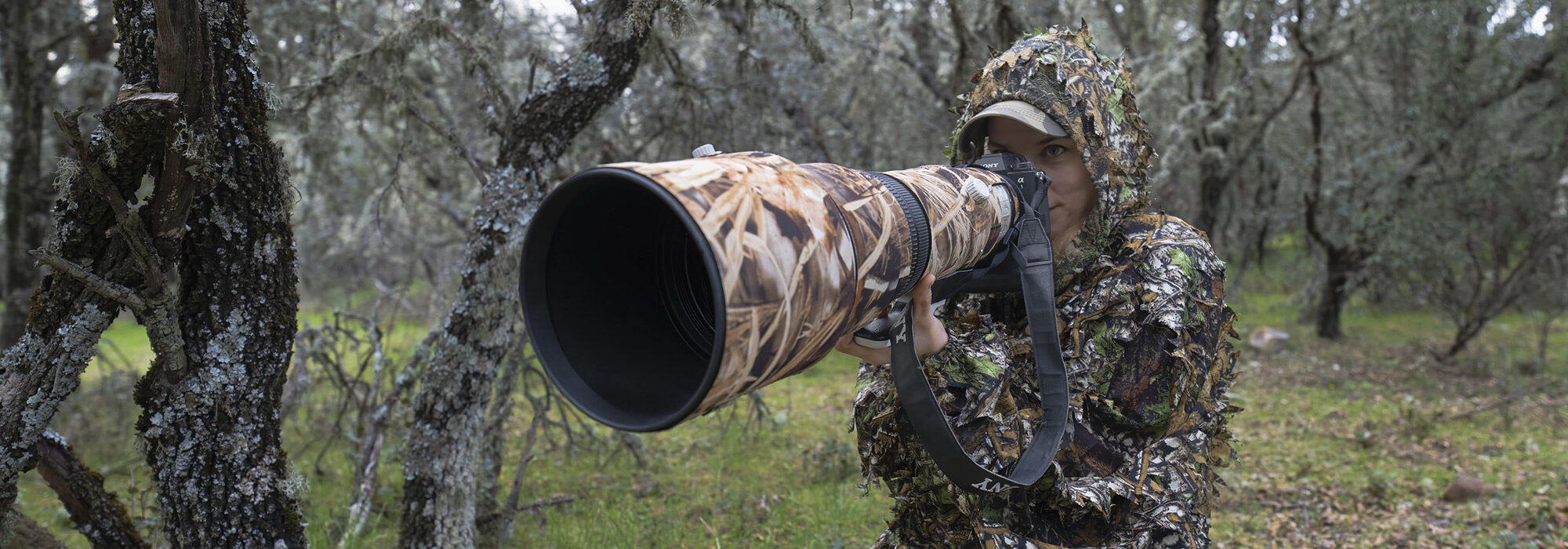
My name is Alexandra Surkova and I’m a professional wildlife photographer based in Spain. Three years ago I wasn’t even using an interchangeable lens camera and was happily taking very ordinary images with my smartphone.
 © Alexandra Surkova | Sony α1 + FE 600mm f/4 GM OSS | 1/1600s @ f/4.0, ISO 800
My career as a wildlife photographer started with a very surreal experience. One day, one of my very few Instagram followers at that time messaged to tell me he saw great potential in my photos and had sent me a gift. Oh boy, that moment when I opened the package and instead of a postcard I saw the Sony FE 200-600mm f/5.6-6.3 G lens! It’s safe to say my life changed at that moment.
I can still clearly recollect my very first photography trip with the new lens – June 24th, 2020. Covid was in full swing and as people vanished from the streets, animals appeared. I spent many hours in a tent in 40-degree heat, covered with sweat, to take only two photos of an owl which in total posed for me for a couple of minutes. But rather than frustrate me, the experience actually got me addicted to wildlife photography.
 © Alexandra Surkova | Sony α7R IV + FE 200-600mm f/5.6-6.3 G OSS | 1/400s @ f/6.3, ISO 1600
Equipment
The Alpha 7R IV was my first Sony camera (this is now the backup camera to my Alpha 1) and when the scene didn’t require excessive speed, it offered me lots of spectacular shots, and the 61-megapixel sensor gave me the flexibility to make a dramatic crop if necessary.
 © Alexandra Surkova | Sony α7R IV + FE 200-600mm f/5.6-6.3 G OSS | 1/500s @ f/6.3, ISO 800
My photography took a huge step forward the day I tried the Alpha 1 and for me it’s the perfect camera – fast, high resolution and the autofocus is just incredible. Just imagine that a tiny grey sparrow is sitting on a branch of a grey tree 50 metres away from you on a rainy day. I’m not even sure that you’ll be able to see the bird, but the Alpha 1 can focus on its eye!
 © Alexandra Surkova | Sony α1 + FE 600mm f/4 GM OSS | 1/800s @ f/4.0, ISO 3200
When I’m reviewing my images on a monitor after a trip, I don’t even need to check if the focus is sharp because 99.9% of them always are, so I love that I only need to concentrate on composition. I honestly can’t find a flaw in this camera, it’s pure magic.
 © Alexandra Surkova | Sony α1 + FE 200-600mm f/5.6-6.3 G OSS | 1/500s @ f/6.3, ISO 800
As for lenses, I have two favourites. The FE 200-600mm f/5.6-6.3 G OSS is a must-have for any wildlife photographer and if I had to choose just one lens, it would be this. It’s fast, versatile and the quality is unbelievable. Being in Spain, one of my greatest pleasures is to search for the Iberian Lynx, one of the most endangered felines on the planet. When you sit in ambush for hours waiting to see one of these rare creatures, you can’t take any risks with your kit. The animal can appear at any distance, walk straight towards you, and even pass within half a metre of your position. You have just a couple of minutes to take your very best shot, and believe me, with your heart beating with excitement, you don’t have time to start changing lenses.
 © Alexandra Surkova | Sony α1 + FE 200-600mm f/5.6-6.3 G OSS | 1/1000s @ f/6.3, ISO 5000
The other lens I wouldn’t be without is the FE 600mm f/4 G Master OSS. It’s like a lens from another league, another world. Sometimes it seems to me that the pictures taken with this lens are more beautiful than the reality itself. The bokeh is insane, it gives an incredible sense of depth and three-dimensionality and the quality leaves me speechless.
 © Alexandra Surkova | Sony α1 + FE 600mm f/4 GM OSS | 1/1250s @ f/4.0, ISO 2000
The Creative Process
I often wonder what I love about wildlife photography so much, and I always return to the same answer: the absolute unpredictability. It’s impossible to plan anything, there are no staged shots and you can never predict the result. You don’t even know for sure if the animal you hope to see will ever show up! You can spend hours in hiding without seeing anyone. Or it may be that you’re hoping to spot an eagle, but instead you see a beautiful fox. Will it pose for you or pass by? You can’t make a wild animal move your way, you are merely a spectator.
 © Alexandra Surkova | Sony α1 + FE 600mm f/4 GM OSS | 1/2500s @ f/4.0, ISO 1000
But with some experience gained, if an animal appears, from that point you can at least vaguely predict its movements. If you are sitting in ambush at a watering place, then even if the animal appeared, at some point it will start drinking, which means it will stick out its tongue. This is the moment I’m waiting for. I’m not interested in doing 1000 frames at high speed. My Alpha 1 allows me to shoot 30 fps, but I rarely use this feature. I’m interested in pressing the shutter release only when I’m sure that the picture might be of interest to me.
 © Alexandra Surkova | Sony α1 + FE 200-600mm f/5.6-6.3 G OSS | 1/640s @ f/6.3, ISO 4000
Final Thoughts
I’m often asked what needs to be done to start making money through photography. I think life is too short to do something that doesn’t satisfy you, but at the same time, it takes time to learn to do well at least one thing that makes you really happy. Realistically, photography is not something that will make you a millionaire; I personally choose not to be, but to enjoy the path that I like so much.
 © Alexandra Surkova | Sony α1 + FE 600mm f/4 GM OSS | 1/2500s @ f/4.0, ISO 2000
How to start? Take photos. And more photos. And more photos. And give them all the time, and love, and affection that you can give. Until recently it has been just a hobby for me. Three years ago I was still taking photos with my phone, but the process drove me crazy to such an extent that it absorbed all my free time. Of course, it’s easier to achieve great results having a good camera, but if you don’t have one, try with a bad one! If you don’t know how to use it, learn! Step by step. If your goal is the result and not the money, the profits will find you and not vice versa.
Featured products


Alexandra Surkova | Spain
Alexandra Surkova is a professional wildlife photographer based in Spain.


