
Travelling Light
Pauline Simon
The best travel photography is a window into another world. To achieve this, the photographer has to immerse themselves in the culture of the destination, diving in with both feet to get the best shots.
For Pauline Simon, a specialist in travel photography and filmmaking, her lightweight Sony Alpha 7C II is her trusted companion when exploring the world. Her recent shoot in Thailand presented a perfect opportunity to explore and immerse herself in the culture of her destination. Speaking of her trip to the Mae Wang district she explains, “I walked through the area so I could see the scene from every angle and get a feel for the landscape and the people before I started taking pictures. I left the dense jungle and moved through rice fields towards a village. Eventually I found a man cooking fish on the fire and spoke to him, before shooting his portrait.”
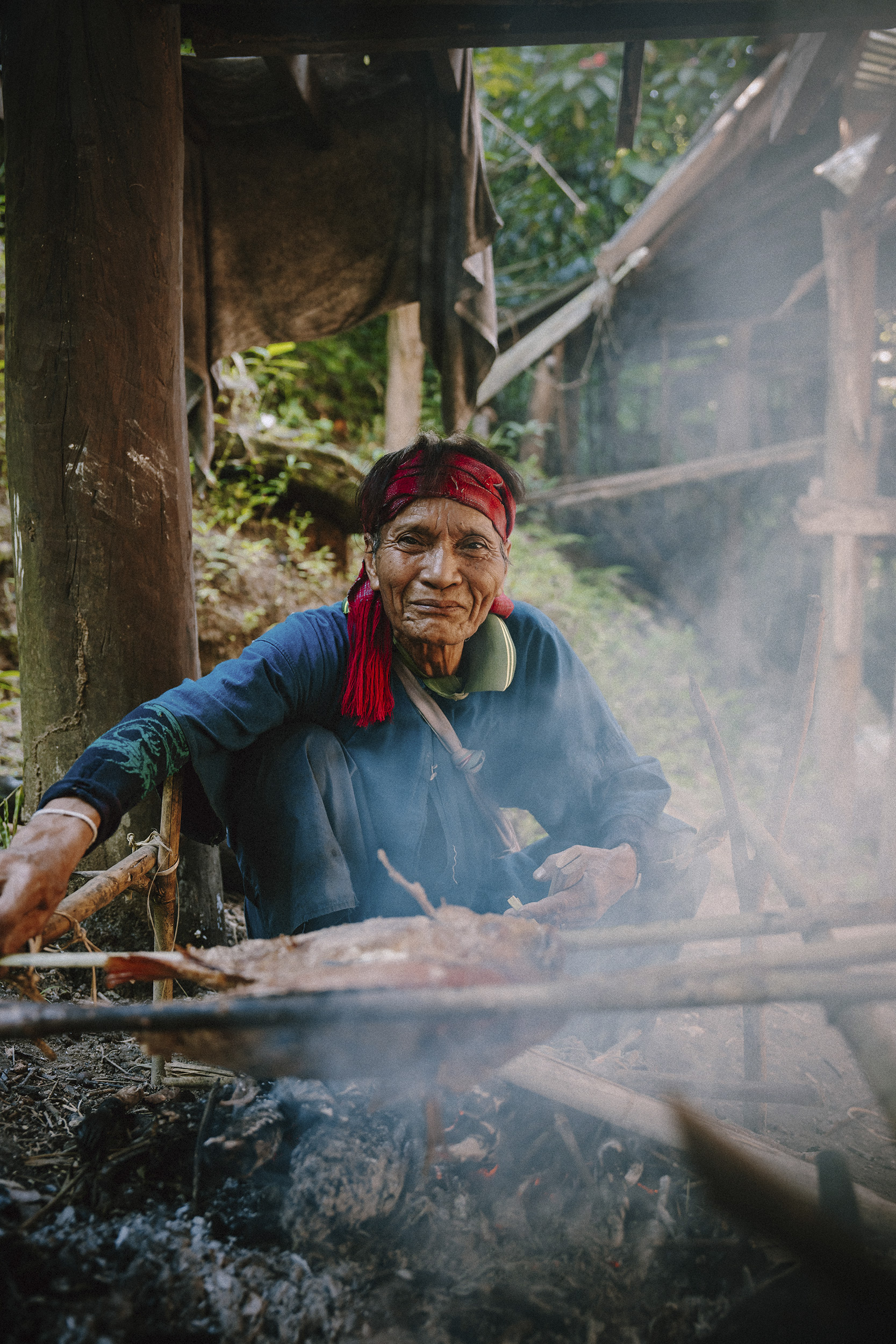 © Pauline Simon | Sony α7C II + FE 24-70mm f/2.8 GM II | 1/125s @ f/2.8, ISO 800
“I love that image,” she continues, “because to me, it portrays Thailand very well in its colour, its energy and how welcoming it is. It’s the same with the woman working in the rice field. I was watching them work, and she said, “come here and help!” We connected and taking her picture was a very, very happy moment.”
 © Pauline Simon | Sony α7C II + FE 24-70mm f/2.8 GM II | 1/50s @ f/2.8, ISO 250
Pauline’s approach is human centred and though her work involves shooting both landscapes as well as portraits, she feels there is more depth in the latter. “I think the most important role of travel photography is to tell a story. People want a story that shows them something new about the world, and those stories always involve people.”
That need for context shows in the composition of Pauline’s images, often framing fairly wide at focal lengths between 35mm and 50mm to show her subjects’ environment. This gives them activity and personality. “Nothing is prepared,” she explains, “and every detail is natural. I like capturing the moments when people are going about their business. To me it has to be authentic and genuine or it doesn’t work.”
“To work in that way, I always have my camera in my hand,” she explains. “That makes it obvious that I'm a photographer, but before I take a shot I always smile, and I try to speak to them. It’s only when I feel that they are comfortable that I just ask if it’s okay to take a picture. Afterwards I always show them the image and we talk more, so it’s always collaborative and natural.”
 © Pauline Simon | Sony α7C II + FE 24-70mm f/2.8 GM II | 1/2000s @ f/2.8, ISO 500
Helping her to achieve this is Pauline’s choice of camera and lens. “Working on this project I used the Alpha 7C II and the FE 24-70mm f/2.8 GM II, because it's the perfect combination for travel, both in stills and video. It was the only camera and lens I took with me, but it’s so versatile that I didn’t need anything else apart from my drone and a microphone.”
“Don’t get me wrong,” she clarifies, “I love my other Sony lenses – like the FE 50mm f/1.2 GM – but when I'm travelling, I just want to immerse myself in a place and not think about gear so much. The FE 24-70mm GM II can do everything I need from portraits to scenic shots, and the f/2.8 aperture is plenty to give me a shallow depth-of-field for separating the subject from the background or letting me shoot in low light.”
With its small size and fleet-footed performance, the Alpha 7C II is not a camera to slow Pauline down either. “It's so light,” she explains, “and that’s very important because these trips involve a lot of hiking. I’m on the go all day, interpreting what I find through the lens, so I need a lot of energy, but I was impressed by the battery life of the Alpha 7C II too. I always take spares for travel assignments – in fact I had six on this trip as there was video work – but I only used one per day, which was a great surprise.”
“For the video I shot in Thailand, it did a great job, too,” she continues. “My main video camera is the Sony FX3, but even though the Alpha 7C II is small and lightweight, it has 4k video in 10bit quality, which is what I need for colour grading. No one wants to go back to 8bit video after they see the extra quality. Plus, on the Alpha 7C II, I can load my LUTs, so I can see what the final result will be like after editing.”
 © Pauline Simon | Sony α7C II + FE 24-70mm f/2.8 GM II | 1/250s @ f/2.8, ISO 640
“As for stills, its 33 megapixel sensor gives brilliant detail,” Pauline says, “and of course for my style of shooting, Sony’s Eye AF is amazing. I don’t want to be messing about with focus or reshooting as that would break the connection with people I’ve met. But the Alpha 7C II picks out faces in a split second and holds them in perfect focus.”
In the end, Pauline says, her role is to discover and document her experiences, and the Alpha 7C II is a camera that doesn’t hold her back. “I always feel stimulated when I'm travelling,” she finishes, “and that comes from getting out of my comfort zone and I love pushing my limits. It’s not something you can do at home. Every time I dive into those experiences, I learn, and grow and become a new person. That's pretty exciting!”


