
In at the Deep End
Dr. Pelayo Salinas de León
Let’s begin at the end. Or at least one possible end. It’s a blissful moment for marine biologist Dr. Pelayo Salinas de León, and one that he won’t soon forget. “This was my fifth visit to Revillagigedo National Park, Mexico, where I was helping my friend and colleague Dr. Mauricio Hoyos to deploy satellite tags on silky sharks and conduct other research on oceanic mantas,” he remembers. “As well as shark tagging, we also dived a lot with the other researchers and park ranger, and of course we took a lot of pictures. It was wonderful returning to this amazing national park and seeing what it had become: flourishing, serene and unspoiled, a wild area with all the joyous diversity of ocean life.”
 © Dr. Pelayo Salinas de León | Sony α1 + FE 16-35mm f/2.8 GM II | 1/200s @ f/8.0, ISO 640
Then something strange happened. Noticing one of the local bottlenose dolphins laying on its back at 33 meters (100 ft) deep, Pelayo and his colleagues were a little confused. “The dolphin was there for three or four minutes, not moving,” he explains, “and so we wondered what was happening. Finally, we realised she was playing dead, like a little puppy! He just wanted us to rub her belly. Despite being wild, these dolphins love to play with humans”
Revillagigedo National Park is a genuine idyll, one that Pelayo says was built on effort and enforcement, and years of protection by the Mexican government, alongside NGOs like his colleague’s Mauricio, Pelagios Kakunja. “The authorities took a bold step in creating this huge reserve, and it’s the biggest ‘no take’ area in North America, which means there’s no fishing. They devoted resources to protect it, and today marine life thrives here. You can jump in the water and find sharks, rays, dolphins, whales… this is what the oceans can be like without harmful human activities.”
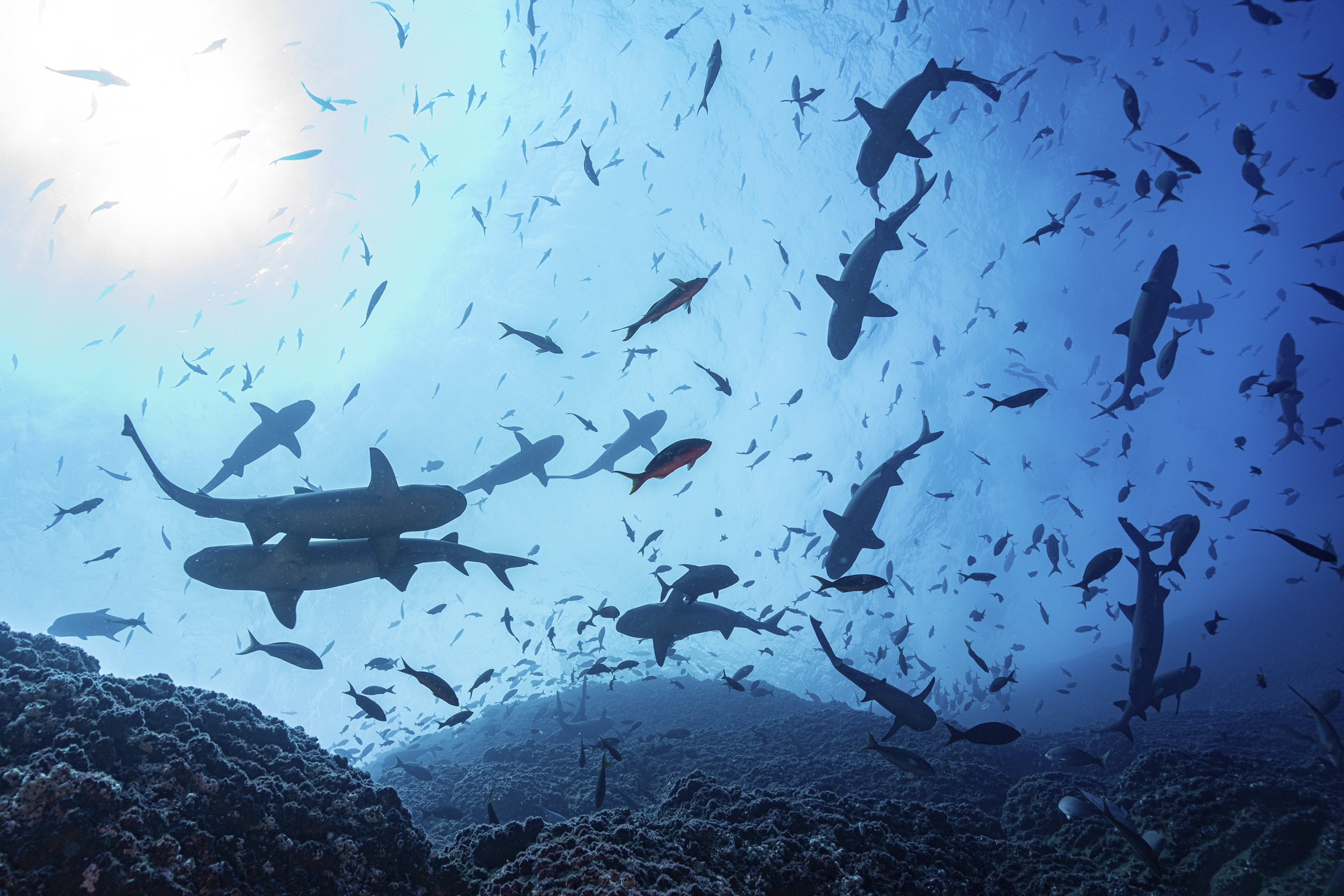 © Dr. Pelayo Salinas de León | Sony α1 + FE 16-35mm f/2.8 GM II | 1/200s @ f/8.0, ISO 250
But sadly, Revillagigedo is not the norm. In fact, unless major action is taken, ‘the end’ for the ocean looks far darker and bleaker than Pelayo’s joyful experience in these warm Mexican waters. “The world’s oceans are in big trouble due to the destructive force of humans,” he says. “Habitat destruction, pollution and climate change have been degrading our blue planet for far too long and many species – and the ecosystems they inhabit – are in severe decline.”
Much of the problem, Pelayo says, is created by the overfishing of marine megafauna like sharks. He’s spent his life studying and trying to protect them in the face of entrenched preconceptions that are baselessly negative. “Unlike many other predators, sharks have terrible PR,” he admits. “The average person has an opinion of sharks that’s based on films like Jaws. That movie damaged the chances of protecting sharks and the perception of them is still suffering today, 50 years later.”
 © Dr. Pelayo Salinas de León | Sony α1 + FE 16-35mm f/2.8 GM II | 1/125s @ f/9.0, ISO 1250
“Fear is driven by the unknown,” he continues. “People think that if they get in the water they’ll be eaten, but any marine biologist will tell you the reality is far from that. We also know that most people aren’t exposed to the ocean; most don’t know how to swim, and they can’t dive. So, they just see what the media portrays. The surface with the unknown beneath. I’m always in the water with sharks, and I’m very comfortable, so it’s up to me to share that message as widely as possible.”
“Because of misconceptions, sharks don’t tend to be as protected as other megafauna,” he continues, “and so they are being fished closer and closer to extinction. Many think this is caused by Asian markets for shark fins, but you’d be surprised how many countries around the world hunt sharks. One of the top shark landing ports is Vigo in northern Spain, where the shark fins are shipped to Asia and a lot of shark meat goes into regular human consumption. Studies have shown that when you go and get your fish and chips, it’s often not cod or haddock as labelled, it’s a shark species.”
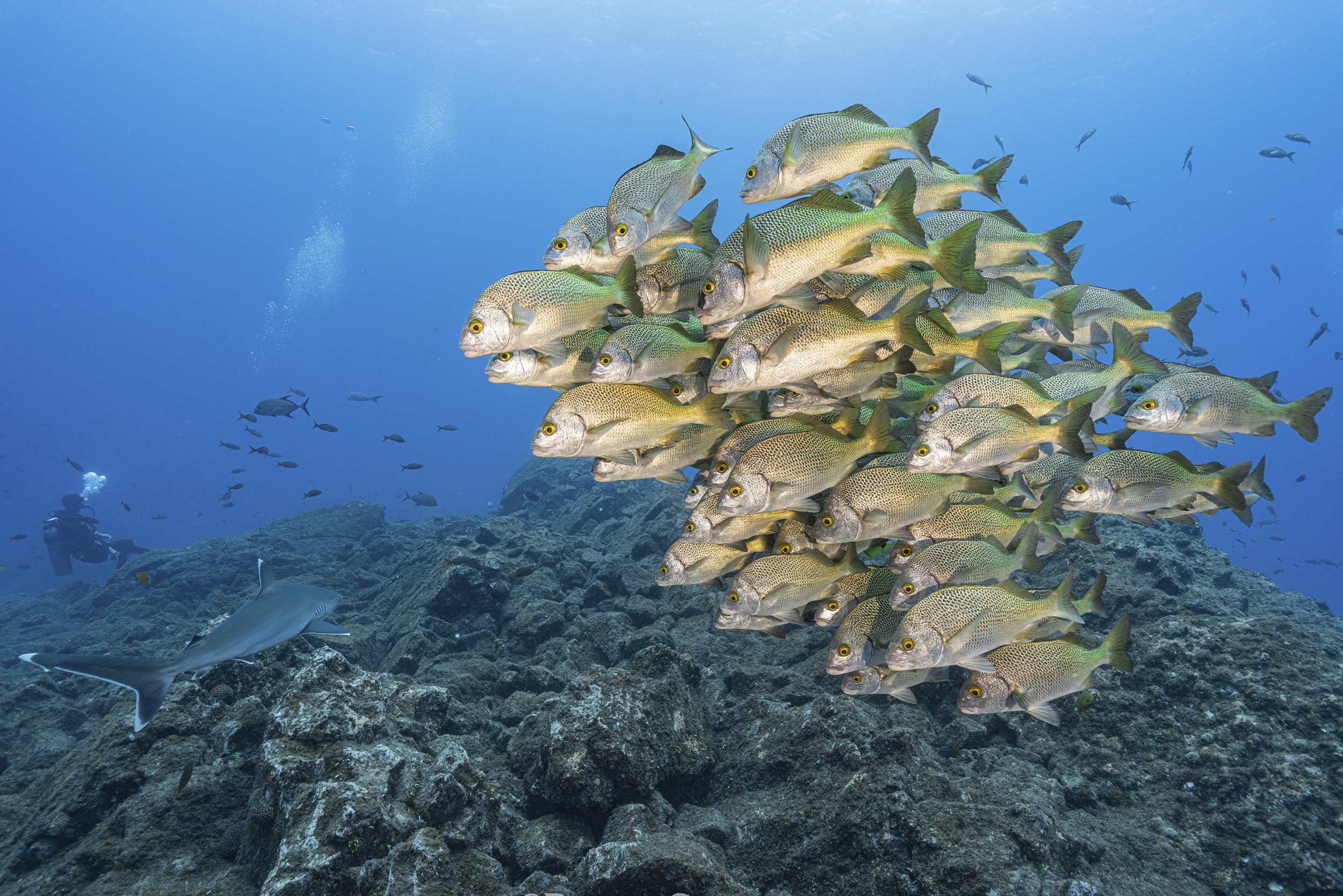 © Dr. Pelayo Salinas de León | Sony α1 + FE 16-35mm f/2.8 GM II | 1/200s @ f/8.0, ISO 800
The victimisation of sharks imperils the whole ecosystem, he explains. “Nature has been running perfectly for millions of years, but it’s easy for us to mess it up. Sharks are the doctors of the ocean, regulating food webs and they specialize in predating on the slow, the weak and the sick. When you remove those top predators, the lower groups become overpopulated, and the system becomes unbalanced.”
So, how to change those perceptions and build a better world for sharks and other marine life, as found in Revillagigedo? For Pelayo, photography and filmmaking are part of the answer. “The underwater world – what goes on below the surface – is understandably alien to us. It’s a vast and challenging environment. By exploring, studying and photographing the last wild places in our blue planet, I want to share the beauty of our oceans so people can relate to it and become advocates for its protection.”
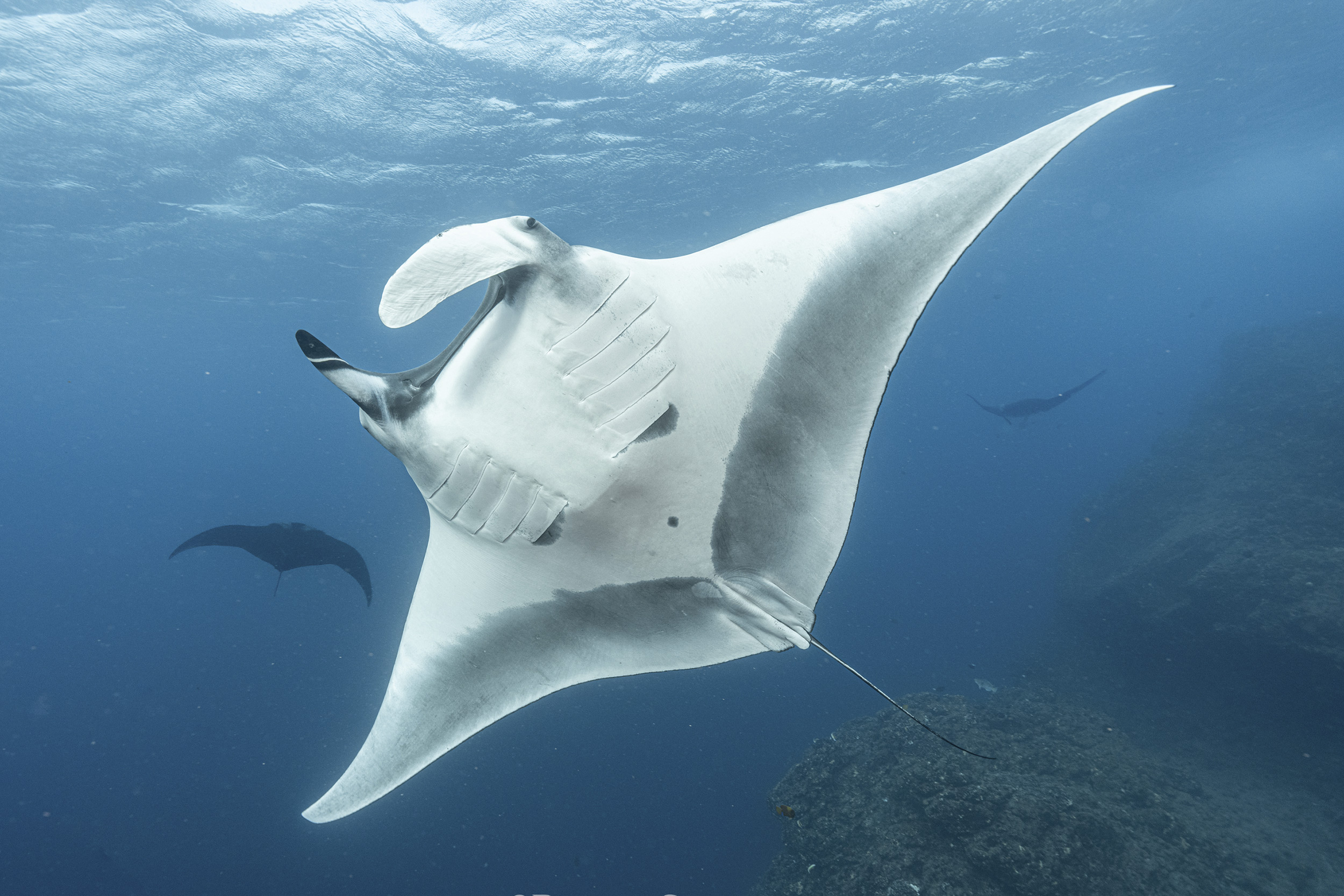 © Dr. Pelayo Salinas de León | Sony α1 + FE 16-35mm f/2.8 GM II | 1/125s @ f/8.0, ISO 640
“Of course, my job is to collect data and generate scientific papers, and that’s vital, but on the other hand, these are things that only the peers in my field will read. Reaching out to a general audience is different and if you can translate the scientific facts and knowledge into something that’s meaningful for the average person, it can be huge. It’s for that reason I never dive without a camera now. I don’t want to miss a moment that could change someone’s mind.”
“Diving at Revillagigedo was my very first adventure with the Sony Alpha 1,” he remembers, “and it’s a camera that’s simply amazing for underwater photography. When you dive, you lose a lot of light, but the Alpha 1’s large sensor and spectacular native and extended ISO range perfectly compensates for this. I shoot both photo and video, so of course, the superb video capabilities are a perfect fit for me, too.”
Within its Isotta waterproof housing specially designed for the camera, Pelayo twinned the Sony Alpha 1 with an FE 16-35mm f2.8 GM II lens for this trip, explaining that “since I wanted to photograph large animals including sharks, mantas and dolphins, along with underwater landscapes like drop offs, walls, open ocean, it was important to use such a high-quality wide-angle zoom. You can’t use telephoto lenses easily underwater anyway, and of course a wide-angle means getting closer to the subject, but that just proves how sharks aren’t to be feared.”
 © Dr. Pelayo Salinas de León | Sony α1 + FE 16-35mm f/2.8 GM II | 1/200s @ f/8.0, ISO 640
“We’ve seen in Revillagigedo, that a brighter future for our oceans is possible,” he finishes, “because the moment you close areas to overfishing and other negative human actions, the ocean has this amazing regenerative power to heal itself naturally. That’s the recipe for success, and the Convention of Biological Diversity has a global target to protect 30% of the ocean in that way by 2030. But these need to be proper reserves and protected in more than just a name.”
“When you see what the ocean can be, you can see the path to a better planet. We know that when we respect the seas, they’re more healthy, and in turn, they regulate earth’s climate, feed us, entertain us and produce most of the oxygen we breathe. The importance is clear. And every photo I take helps me advocate for that.”


